Actively contribute towards a more resilient Europe
Re-think and Re-tool for EU pandemic resilience
NEVER AGAIN
Our survival, well-being and happiness depend on the resilience of our systems. Covid-19 pandemic highlighted the fragility of our social, environmental, economic and political systems. The future of EU must be resilient to protect our health, our way of life and our democracy and individual freedoms.
In the past we have addressed scenarios, value chains, city planning, medical services as separate silos of data and value. With the crisis comes the opportunity to Re-think and Re-tool to address the society as a complete system. We need to build anti-fragility into all systems by breaking apart the data silos that separate them and building a more complete, holistic model so that we can make our society more resilient.
Your contribution can help achieve new standards of resilience for the European Union in times of pandemics and raise the level of preparedness in all Member States. Together we are strong and we can help build a better Europe for everybody.
EU Pandemic Resilience
What went wrong
Discover all areas impacted by COVID-19 and read insightful observations on how systems in the European Union were stressed beyond their response capacity.
Early warning
Lack of initial information
A pneumonia of unknown cause detected in Wuhan, China was first reported to the WHO Country Office in China on 31 December 2019. On 30 January, WHO declared the outbreak a Public Health Emergency of International Concern (PHEIC). On 11 March, WHO Director General characterized COVID-19 as a pandemic.
The European Union has come under fire for its slow response in the coronavirus outbreak. Although there have been large efforts to address the crisis at European level, not all measures were timely agreed by the Member States
The EU response to the COVID-19 pandemic has exhibited a lack of coordination between Member States in terms of public health measures including the restriction of movement of people within and across borders and the suspension of other rights and laws; the economy has been put on hold with dramatic effects of disruption
on European citizens, self-employed, businesses and workers.
Containment measures effectiveness depend on how efficiently we communicate them
Containment measures work only as long as people are willing to abide by them. And people's willingness is directly proportional to how the message is communicated and how often.
The Lombardy doctors said that two major measures may have alleviated the severe stress the outbreak has placed on the region's health systems: an immediate increase in COVID-19 lab testing and creation of a large facility just for infected patients. More resources should be invested to contain the epidemic.
The strain on the health systems was not only logistic
Before, the health services, here in Italy, as in most European countries, were focused on individual care. But now they have to start thinking about public health in an outbreak context instead.
Europe didn't bet on domestic big tech development and has nothing to counteract the losses from the most hit sectors. The big winners are the big American tech companies
In Germany, the biopharmaceutical company Curevac is using the so-called messenger molecule - mRNA - in a vaccine. It's a totally new approach in medicine.
People and businesses may be impeded to seek justice
There may be situations where citizens and businesses need to take procedural action in a cross-border case, but are unable to do so due to emergency measures taken in an EU Member State in order to counter the spread of the COVID-19 virus
In Spain, austerity legacy cripples coronavirus fight. Major cuts and wave of privatization has left health care system unprepared to deal with an epidemic.
COVID-19 is forcing cities around the world to face the reality that they're ill-prepared for emergencies. It’s time to reinvent the modern urban center with an eye toward fully equipped health systems and state-of-the-art digital infrastructure that incorporates unanticipated risks.
The EU’s internet infrastructure is ‘under strain’ and a series of measures should be implemented by online streaming platforms as a means to mitigate the higher demand for bandwidth amid the current coronavirus quarantine period
Contribute to achieve resilience by design in the EU
Submit your idea, research or project to contribute to one or more areas of improvement.
Since the Covid-19 outbreak the European Union, its Members States and the entirety of its population have struggled with the direct and indirect effects of the pandemic. Researchers are addressing the first emergency by working on a vaccine. Our essential workers are keeping the systems working and the supermarkets and pharmacies well supplied. The rest of us can contribute in an equally important manner: by finding solutions for resilience by design we can make it so this kind of pandemic can never affect us all like this again.
You can choose one or multiple areas of improvement and submit a paper, a research, a set of data or an entire project. After the initial submission you can initiate a collaboration or join an existing team to add your contribution. You can also search articles and projects submitted by other contributors and join their initiatives.
Choose your area of interest
Support an Initiative
Select by type
Select by topic
Most recent
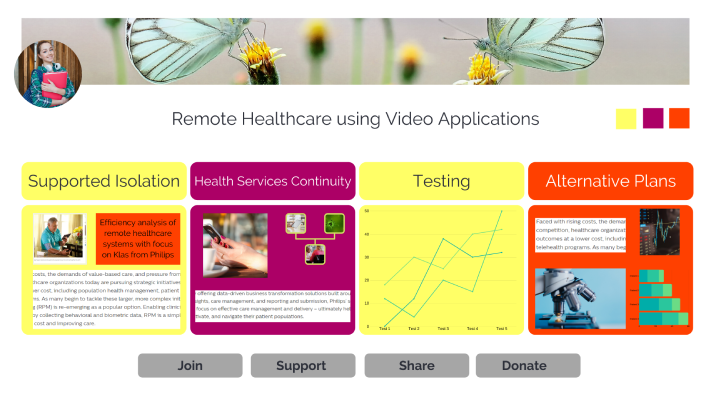
Remote Healthcare using Video Applications
Topics :
Type : Project
Status : Completed
Last updated 2 days ago
Early Warning
Outbreak detection45%
Response scenarios100%
Outbreak Control scenarios85%
Trends monitoring60%
Total54%
Quick Response
Rapid intervention plans30%
Adaptation procedures85%
Containment co-ordination15%
Preparedness for scaling successful measures25%
Total39%
Effective Communication
Capacity to scale communication100%
Communication continuity85%
Correct identification of main concerns95%
Relief efforts data availability85%
Data availability on planned initiatives100%
Total93%
Healthcare System Readiness
Adequate budgeting85%
Logistics preparedness50%
Pandemic mentality preparedness10%
Suitability of strategic reserves75%
Supply chains continuity65%
Human resource reserves65%
Adequate protection for medical personnel50%
Total57%
Virus transmission deceleration
Tracing25%
Testing25%
Supported isolation60%
Total37%
Essential services continuity
Health services continuity65%
Education services continuity85%
Social protection75%
Infrastructure maintenance95%
Water & energy supply continuity100%
Internet & com availability82%
Total84%
Workers' Safety
Prevention of job losses65%
Essential workers safety during pandemic75%
Workers safety and pandemic resurgence avoidance75%
Total72%
Economy Usage
Rapid digitization22%
Manufacturing & industry conversion2%
Maintenance of supply chains62%
Fast re-skilling of workers2%
Limitation of dependency on imports15%
Total21%
Research & Innovation
Adequate financial support78%
Multiple-path mentality35%
Start-ups and SMEs protection65%
Data security80%
Total65%
Protection Against Disinformation
Detection capacity15%
Analysis capacity12%
Capacity to limit exposure10%
Fast enabling of joint responses85%
Industry & platform standards75%
Capacity to raise awareness95%
Total49%
Virus Resurgence Prevention
Early resurgence detection75%
Testing25%
Trends monitoring60%
Alternative plans85%
Total61%
Citizens' Protection
Prevent social unrest65%
Tackle domestic violence15%
Tackle psychological effects10%
Protect vulnerable citizens75%
Emergence of new vulnerable groups50%
Total43%
Protection of Human Rights, Justice & Democracy
Ensure human rights85%
Justice system continuity75%
Secure democratic elections85%
Total82%
Limitation of Underlying Vulnerabilities
No poverty or exclusion78%
Gender equality75%
Finance the austerity legacy60%
Reduce inequality25%
Address economic dysfuntionalities10%
Address attempts to weaken democracy85%
Focus on people25%
Limit lobbying during pandemic10%
Penalize companies exploiting the system during pandemic15%
 Early warning
 Quick response
 Effective Communication
 Healthcare System Readiness
 Virus transmission deceleration
 Essential services continuity
 Workers' Safety
 Economy Usage
 Research & Innovation
 Protection Against Disinformation
 Virus Resurgence Prevention
 Citizens Protection
 Protection of Human Rights, Justice & Democracy
 Limitation of Underlying Vulnerabilities
 Design for resilience